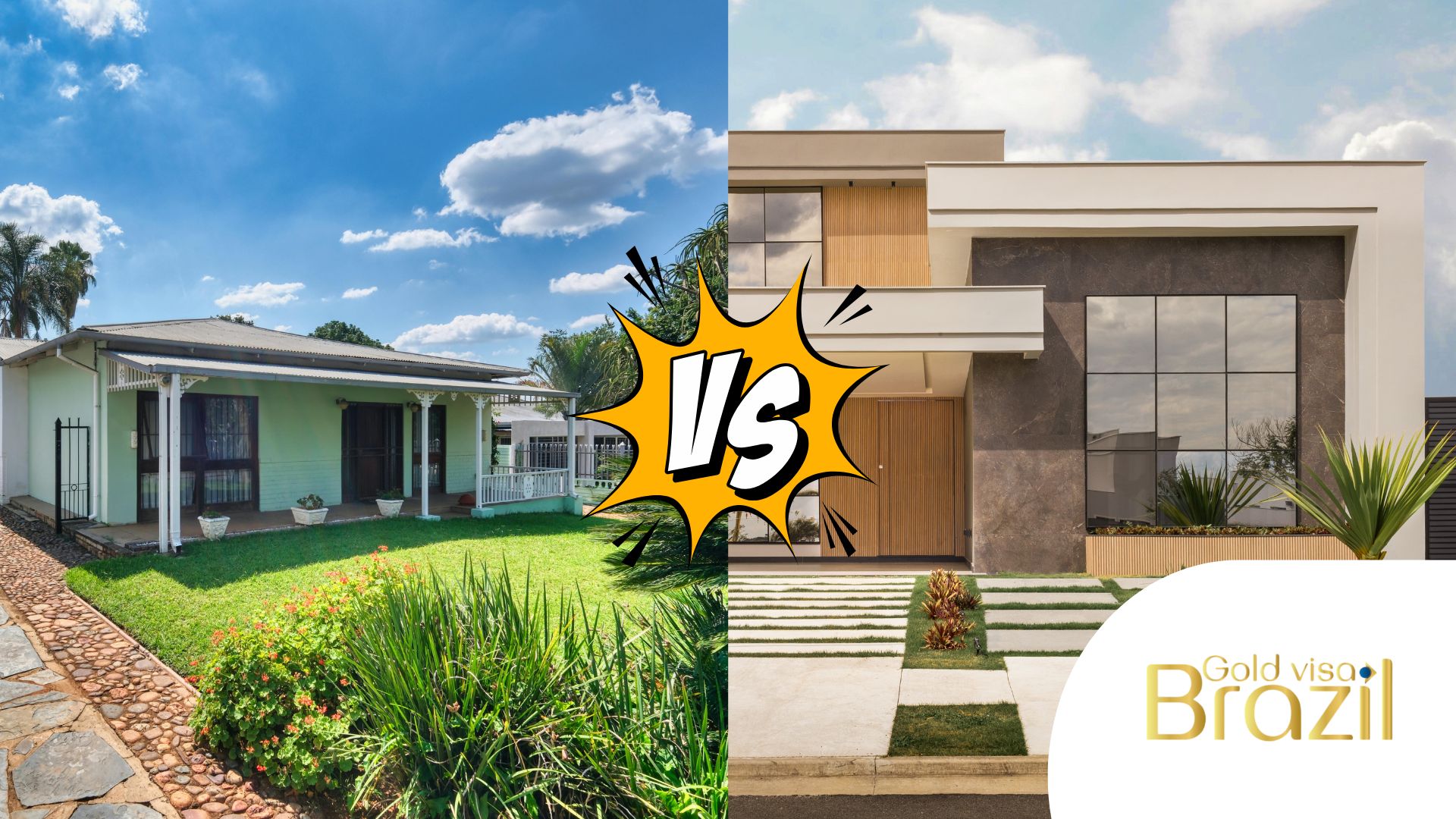
If you’re considering Brazil’s real estate investor residence pathway, one of the first practical decisions you’ll face is this: should you buy a property that’s already built, or invest in a new development that’s still under construction?
Both options are allowed under RN 36/2018. But they’re not treated the same way when it comes to documentation and proof.
The distinction matters because the paperwork you’ll need to submit, the timeline you’ll be working with, and the administrative steps you’ll follow are different depending on which route you choose.
This article breaks down how RN 36 treats ready properties versus off-plan purchases, what documents each path requires, and how to think about the trade-offs if you’re targeting Rio de Janeiro.
What RN 36 says about property type (the two paths it recognizes)
Normative Resolution No. 36 (RN 36/2018), published on Brazil’s Immigration Portal, explicitly recognizes two types of real estate investments for residence purposes:
Properties that are already built (imóveis prontos) meaning the construction is complete, the property is registered, and ownership can be transferred immediately.
Properties under construction (imóveis em construção) meaning you’re buying into a development that hasn’t been completed yet, typically through a promissory purchase agreement (promessa de compra e venda).
Both paths are valid. But the resolution sets different documentation requirements for each, and those differences have real implications for how you structure your investment and application.
Ready property: what you need to prove (and why it’s more straightforward)
When you buy a property that’s already built, the documentation pathway is relatively clean.
Under RN 36, you’ll typically need to provide:
The property registry document (matrícula) showing that you are the registered owner, that the property is free of liens or encumbrances, and that the legal description is clear.
Proof of international capital transfer (declaração de ingresso de capitais) from a Brazilian financial institution, attesting that the funds used for the purchase came from abroad.
The deed or purchase agreement showing the completed transaction.
The key advantage here is simplicity: the property exists, ownership is clear, and the paper trail is straightforward.
You’re not waiting for construction to finish. You’re not relying on a developer’s timeline. You’re buying something real, tangible, and already registered in the official system.
For investors who value certainty and want to move quickly, the ready property path is often the cleanest option.
Off-plan property: what changes (and why the documentation is more complex)
When you buy a property that’s still under construction, the documentation requirements shift.
Under RN 36, you’ll typically need to provide:
The registered promissory purchase agreement (promessa de compra e venda registrada) showing your contractual commitment to buy the property once construction is complete.
Proof of international capital transfer for the amounts you’ve already paid (down payment, installments, etc.).
Construction and incorporation documents referenced by the resolution, which may include the developer’s registration, construction permits, and incorporation documents (memorial de incorporação).
The key difference is that you don’t yet own a completed property you own a contractual right to a property that will exist in the future.
That’s not inherently bad, but it does add layers:
- You’re relying on the developer to finish the project on schedule;
- Your documentation needs to prove not just that you made a purchase, but that the purchase is part of a legally structured, registered development;
- If there are delays or complications with the construction, those can ripple into your residence timeline
For investors who are comfortable with development risk and who see value in newer buildings, location, or price, the off-plan route can make sense but it requires more careful documentation and more realistic timeline expectations.
Why this matters in Rio (and especially in Barra da Tijuca)
Rio de Janeiro offers both ready properties and new developments, but the mix varies significantly by neighborhood.
In Barra da Tijuca, new construction is common. The neighborhood continues to grow, and many foreign investors are drawn to modern buildings with amenities, newer infrastructure, and competitive pricing per square meter.
If you’re targeting Barra and you’re open to off-plan purchases, you’ll have a wide range of options but you’ll also need to be realistic about construction timelines and developer track records.
In Zona Sul neighborhoods like Ipanema, Leblon, and Copacabana, most of the real estate is established.
New developments exist, but they’re less common, and prices per square meter are higher.
If you’re buying in Zona Sul, you’re more likely to be working with ready properties, which simplifies your documentation but may limit your options in terms of modern amenities and layouts.
The strategic takeaway: your neighborhood choice and your property type choice are connected.
Understanding the documentation implications of each helps you plan better.
The timing question: which path is faster?
From a pure documentation perspective, ready properties tend to move faster.
You’re not waiting for construction milestones. You’re not coordinating with a developer’s schedule. You’re working with a property that exists, and once the transaction closes, your ownership is immediate.
For off-plan properties, the timeline is more complex:
- You might need to wait for certain construction stages to be reached before you can register ownership;
- Your residence application will be tied to proof of payment and contractual commitment, not yet to full ownership;
- If the developer experiences delays, your plans may need to adjust
That doesn’t mean off-plan is always slower it just means the timeline has more variables, and those variables are partially outside your control.
If speed and certainty are priorities, ready properties have an advantage.
If timing flexibility and access to new developments are more important, off-plan can still work but you’ll need to plan for contingencies.
Risk and control: the trade-off most investors overlook
Beyond documentation, there’s a practical risk question worth considering.
When you buy a ready property, you can inspect it, walk through it, verify its condition, and confirm that it matches the description.
You know exactly what you’re buying.
When you buy off-plan, you’re relying on:
- The developer’s reputation and track record;
- Architectural plans and promises;
- Construction timelines that may or may not be met;
- The legal protections built into Brazilian real estate law for pre-construction buyers
Brazilian law does provide some protections for off-plan buyers (such as the legal mechanism known as patrimônio de afetação, which segregates project funds), but those protections do not eliminate risk — they only mitigate it.
Our legal and real estate team handles developer due diligence, contract review, documentation analysis, and purchase structuring to minimize exposure and ensure full compliance with RN 36 requirements.
Which one is “better”? (The answer depends on your plan)
There’s no universal answer.
Ready properties offer simplicity, certainty, and faster timelines. Off-plan properties offer access to new developments, modern layouts, and sometimes better pricing but with more complexity and timeline risk.
The right choice depends on:
- Your timeline and how quickly you need to close;
- Your risk tolerance and comfort with developer reliance;
- Your target neighborhood and what’s available;
- Your documentation readiness and willingness to handle extra administrative layers
Our team conducts this comparative analysis for you reviewing documentation requirements, timelines, compliance risks, and investment structure so you can make a confident decision aligned with your residency strategy.
Want help navigating the ready vs. off-plan decision in Rio?
If you’re weighing your options between ready properties and new developments in Rio and you want to understand exactly what documentation each path requires under RN 36 our team can structure, coordinate, and manage the entire process on your behalf.
From property selection and developer verification to capital transfer documentation and immigration compliance, we ensure your investment pathway is clear, compliant, and strategically aligned with your residence goals.
Reach out to the Gold Visa Brazil team to discuss your investment goals, your timeline, and how we can manage the documentation and structure the property type that best fits your strategy without unnecessary complexity.
And keep following our blog we’re publishing practical, source-backed guides for foreign investors building a real plan in Brazil, without hype and without unpleasant surprises.